After the Crash: What Milam County Families Should Know About 18-Wheeler Wrecks
Second in a series on crashes on Milam County roads. The first installment, "It Starts With the Driver," reported on the October 28 community meeting on FM 485, where residents, the Sheriff's Office, and Commissioner James Denman took up that road's toll of crashes and deaths.

That meeting was about one road. But the questions raised there — why do these crashes keep happening, and who is really responsible when they do — apply to every road in this county.
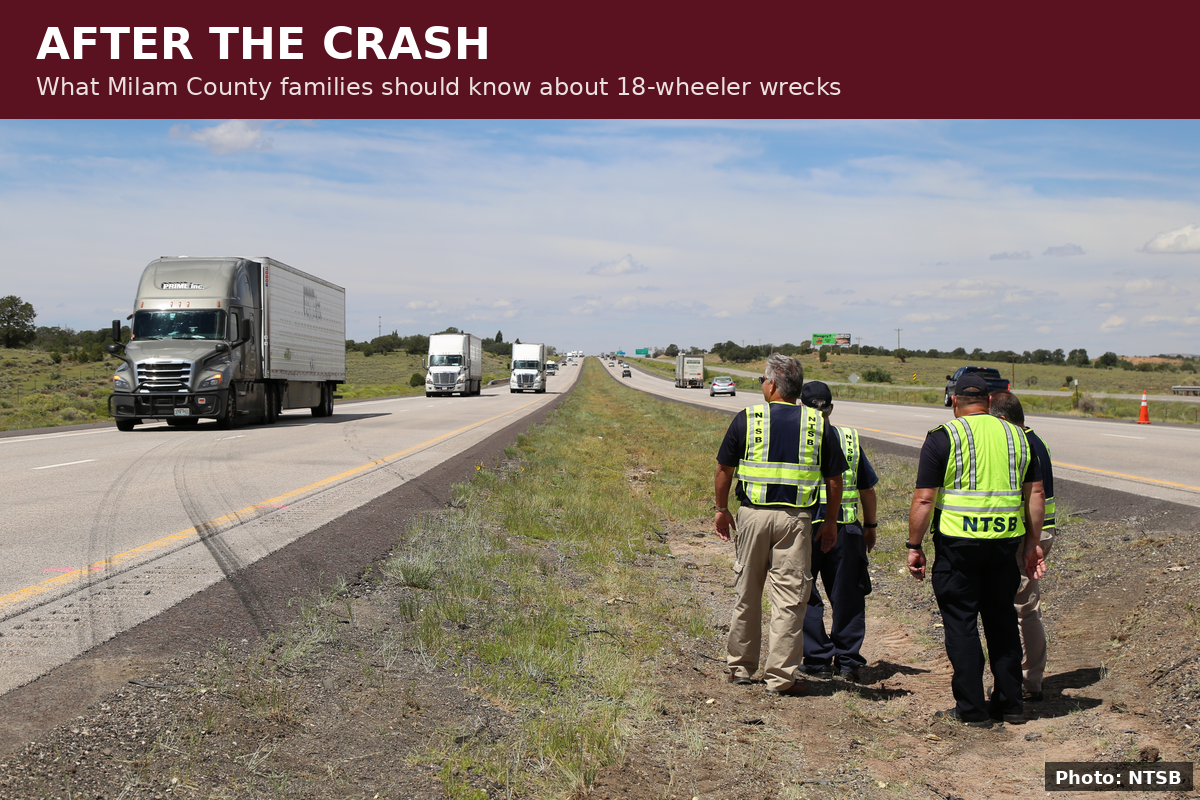
Milam County drivers share the road with 18-wheelers every day — on U.S. 77 and U.S. 79, on the state highways, and on farm-to-market roads that were never built for the traffic they now carry.
Residents along FM 485 know the danger better than anyone. At the community meeting held October 28, Chief Deputy John Mendoza of the Milam County Sheriff's Office put the number at roughly 220 crashes on that one road since January 2023, including seven deaths. When a crash involves a loaded tractor-trailer, the outcome is rarely a fender-bender. A fully loaded 18-wheeler can weigh 80,000 pounds — about twenty times the weight of a family car.
What many families don't learn until it happens to them is that a truck wreck is not like a car wreck — not in the damage it does, and not in what happens afterward. Here is what to know before you ever need it.
The driver is only the first place to look
When an 18-wheeler causes a crash, the driver matters — fatigue, distraction, and speed are behind many of these wrecks. But experienced investigators don't stop at the driver, because the driver's choices were often set in motion long before the crash:
- The trucking company hires the driver, sets the schedule, and maintains the truck. Companies that pressure drivers to run past their legal hours, skip safety training, hire drivers with poor records, or put off repairs share responsibility for what happens on the road.
- The broker is the middleman that matches loads to trucks. Some brokers hand freight to the cheapest carrier available without checking its safety record.
- The shipper — often a large corporation — chooses who hauls its goods. A company that hires a cut-rate carrier with a poor safety history to save money has made a decision that affects everyone on the road.
That is why these cases are investigated in layers. The question is never only what happened in the seconds before impact. It is also what the companies involved did, and failed to do, in the months before it.
The evidence doesn't wait
Trucking companies and their insurers move fast after a serious crash — often within hours. Meanwhile, some of the most important evidence in a truck case is perishable:
- The truck's electronic data recorder and the driver's hours-of-service logs
- Dash-camera and GPS records
- Maintenance and inspection files
- The driver's qualification and training records
Records get overwritten, repaired, or lost as a matter of routine. Families who wait months to ask questions may find the answers are gone.
Washington wants to know why these crashes happen — and it's paying to find out
There is a new reason to document these crashes carefully, and it comes with a deadline.
On November 3, the Federal Motor Carrier Safety Administration (FMCSA) announced its Crash Causal Factors Program Heavy-Duty Truck Study — a nationwide study that will examine, in depth, approximately 2,000 fatal crashes involving heavy-duty trucks across about 30 states over two years. The study focuses on Class 7 and Class 8 trucks — the big rigs, 26,001 pounds and up — which FMCSA says account for roughly 70 percent of the large trucks involved in fatal crashes.
To get that data, FMCSA is offering up to $7 million in one-time competitive funding, with individual awards of up to $500,000 and no local match required. States selected for the study, and local law enforcement agencies in them that meet the study's participation requirements, can apply. The money pays for exactly the work described above: post-crash inspections, in-depth investigations, crash reconstructions, data reporting, and equipment for the job.
FMCSA has said plainly that this funding will be offered only once. Applications are due December 28, 2026.
Why does that matter in Milam County? Because the question this study asks — what actually causes fatal truck crashes — is the same question residents along FM 485 have been asking about their own road. National answers start with local data: what gets documented at the scene, by the officers who respond, in counties like this one. Whether Texas agencies take part, and whether any of that funding reaches the departments that work our most dangerous roads, is worth watching — and worth asking about while the window is open.
If it happens to your family
- Call 911 and get medical care first, even if injuries seem minor. Some serious injuries show up days later, and medical records created right away matter.
- If you can do so safely, photograph the vehicles, the road, skid marks, and road conditions — or ask someone to do it for you.
- Don't give a recorded statement to the trucking company's insurer, and don't sign anything, before you understand your rights. Early settlement offers are built to close a case cheaply, before the full cost of an injury is known.
- Keep everything — medical bills, repair estimates, pay records for missed work, and notes about how the injury affects daily life.
- Talk to a lawyer who handles truck cases before the evidence window closes. These cases are not handled the way ordinary car-wreck claims are.
You don't have to leave Cameron to find that lawyer
Many Milam County families assume a case like this means hiring a firm in Austin, Waco, or Houston. It doesn't.
Cappolino, Dodd & Krebs LLP, at 312 S. Houston Ave. in Cameron, handles 18-wheeler collision lawsuits — including investigating the trucking company, broker, and shipper behind the driver. The firm offers free consultations and can be reached at (254) 697-4965 or toll-free at (888) Meso-Firm, and through RespectForYou.com.
[Editor's note: The publisher of the Cameron Community Voice, Jillian Morris, works part-time at Cappolino, Dodd & Krebs LLP.]

Nobody plans for the phone call that follows a serious crash. But knowing how these cases work — and that help is available right here in Milam County — is something every family that drives these roads deserves to know ahead of time.