
Get to Know Your Candidate: Ted Brown — U.S. Senate
Ted Brown is not running for the U.S. Senate to write new laws. "I am not running for U.S. Senator to be a 'lawmaker,'" the Austin Libertarian says.


Ted Brown is not running for the U.S. Senate to write new laws. "I am not running for U.S. Senator to be a 'lawmaker,'" the Austin Libertarian says on his campaign website. "I am running to repeal as many laws as I can." Brown — whose full name, Theodore E. "Ted" Brown Jr., appears on his federal candidate filing — is the third name Milam County voters will see on the ballot for U.S. Senate.
Who he is
Brown was born in Steubenville, Ohio, and comes from a family of immigrants, a heritage he cites often. On his campaign site he tells how one great-grandfather, a Lithuanian Jew, fled anti-Semitism in Czarist Russia in 1890, and another fled forced military service in Germany in 1904. He earned a bachelor's degree in political science, with a concentration in constitutional law, from UCLA in 1984.
He spent his career in the insurance industry and retired as a self-employed independent claims adjuster and investigator. He and his wife live in Austin, and they have an adult daughter.
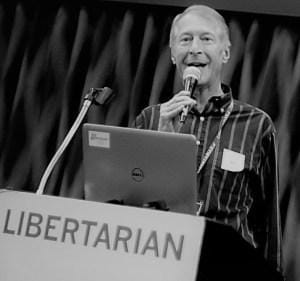
Brown has been a Libertarian activist since his college days and has spent much of his adult life inside the party — holding, in his words, "many leadership roles in the party, like state chairman." He ran for the U.S. Senate in 2024 against Sen. Ted Cruz and received 267,000 votes, which he notes was a record for a Texas Libertarian Senate candidate. Libertarian delegates chose him again at their state convention on April 11, 2026, giving him 64.3 percent of the convention vote over Daniel Mark Sims.
What he stands for
Brown's platform starts with the tax code. He wants to "repeal the income tax, abolish the IRS, and replace them with nothing," pairing the largest tax cut in American history with massive across-the-board spending cuts. The national debt — approaching $39 trillion — is, he argues, unsustainable.
He would also reassert what he calls the Constitution's separation of powers, limiting presidential emergency powers, executive orders, tariff authority and war-making. On foreign policy he is a non-interventionist: bring the troops home, close overseas bases, cut foreign aid, and end America's role as "the world's policeman." At home he champions personal freedom, economic freedom and digital privacy, opposing digital ID systems and government-mandated age verification online.
On immigration, he would abolish ICE and replace the current system with an Ellis Island–style one: welcome newcomers at any port of entry after screening for criminal records and disease, let them work from day one, and build no wall. His closing argument is simple: "The other candidates for U.S. Senator in all other parties want to run your life. I am the candidate who wants less."
Texas voters will decide the race on the Nov. 3 general election ballot. Early voting runs Oct. 19–30.