
COMMUNITY SAFETY: Understanding Local Sex Offender Registry Tracking and Child Safety as Summer Begins
According to database records from the Milam County Sheriff’s Office, approximately 75 registered sex offenders reside within the unincorporated, rural areas of the county.

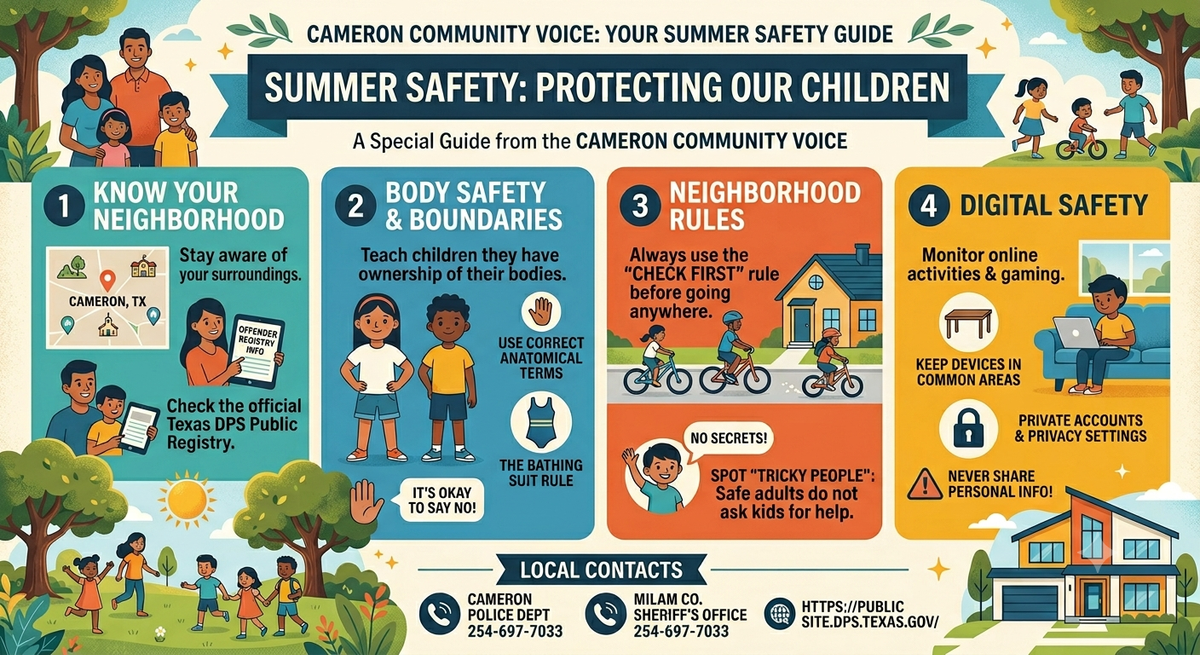
Cameron, TX - As the final school bells ring across Milam County this week, local households are transitioning into a familiar summer rhythm. Backpacks are being tossed aside for bicycles, and children are preparing for long, sun-filled days playing outside, visiting municipal parks, and navigating digital spaces.
However, the start of summer vacation also brings a shift in daily routines. With children out of the structured, heavily supervised school environment, parents are naturally looking closer at neighborhood safety. This heightened awareness comes alongside what many local residents have noted as a recent influx of law enforcement notices, registry updates, and localized bookings involving registered sex offenders.
Local safety coordinators emphasize that this apparent surge is largely a reflection of localized enforcement cycles rather than a sudden influx of new offenders moving into the region.
Behind the Numbers: Active Law Enforcement
According to database records from the Milam County Sheriff’s Office, approximately 75 registered sex offenders reside within the unincorporated, rural areas of the county. When factoring in the municipal city limits of local towns—where municipal police departments maintain separate oversight—the countywide baseline generally reaches between 120 and 130 tracked individuals.
The recent concentration of public notifications and compliance arrests stems primarily from the rigorous tracking laws established under Chapter 62 of the Texas Code of Criminal Procedure. State law dictates that individuals on the registry must verify their residential, employment, and online information on strict cyclical schedules—ranging from annually to every 30 or 90 days, depending on their court-designated risk assessment level.
Local agencies, including the Milam County Sheriff’s Office Special Investigations Unit (SIU) and area police departments, routinely conduct unannounced, localized compliance sweeps ahead of major seasonal shifts. Because offenders are legally required to report any modification to their address, vehicle, phone number, or internet identifiers within seven days, these sweeps frequently result in brief clusters of "Failure to Comply" felony charges. When these localized operations wrap up, automated neighborhood notification apps and public data feeds update simultaneously, creating the perception of a local spike.
Local Zoning and Public Spaces
For families utilizing community spaces over the summer break, both Cameron and Rockdale maintain localized municipal ordinances designed to establish protective perimeters around children.
In Rockdale, Article 8.05 legally bars registered individuals from establishing a temporary or permanent residence within 1,000 feet of designated child safety zones. Cameron maintains similar strict radius restrictions. These legal buffers apply explicitly to public and private school campuses, licensed daycares, municipal playgrounds, youth video arcades, and public parks.
BY THE NUMBERS
- Estimated active registry counts across Milam County jurisdictions.
|Milam County (Unincorporated) | ~75 |
| City of Rockdale (Zip 76567) | 25–30 |
| City of Cameron (Zip 76520)| 15–20 |
| Total Countywide Baseline | 120–130 |
LEGAL FRAMEWORK
- Texas Code Chapter 62: Governs mandatory registration periods. Verification intervals range from every 30 days to annually based on court-assigned risk.
- Child Safety Zones: Rockdale Ordinance Art. 8.05 and Cameron municipal codes ban registered individuals from residing within 1,000 feet of schools, parks, playgrounds, and daycares.
PUBLIC CONTACTS
- Milam Co. Sheriff's Office (Non-Emergency Contact): 254-697-7033
- Statewide Database (Texas DPS Public Registry): publicsite.dps.texas.gov
Practical Steps for Summer Family Safety
National child protection organizations have increasingly shifted away from generalized "stranger danger" modeling, advising families to focus instead on clear boundary literacy and open communication. Safety educators recommend incorporating a few fundamental family guidelines into the summer routine:
- Identify "Tricky People" Rather Than Strangers: Teach children that safe, responsible adults do not ask minors for help, directions, or assistance finding lost pets. A safe adult will always seek assistance from another adult.
- The "No Secrets" Rule: Establish an explicit family dynamic that distinguishes between fun surprises (like a birthday gift) and secrets. If any adult or peer asks a child to keep a secret from their parents, the child should know to report it immediately.
- The "Check First" Boundary: Children should be in the habit of seeking direct parental permission before changing locations, entering a neighbor’s home, or accepting any gifts, rides, or snacks—regardless of how well they know the individual.
- Reinforce Body Autonomy: Use correct anatomical terminology and establish that areas covered by a traditional bathing suit are strictly private. Allowing children to dictate their own comfort levels with physical affection (such as opting for a high-five or wave instead of a forced hug with acquaintances) builds foundational boundary confidence.
- Monitor Digital Front Doors: With more unstructured time spent indoors, online spaces like gaming platforms (Roblox, Fortnite) and social chat channels become primary points of contact. Safety experts advise keeping internet-enabled devices restricted to common household areas like kitchens or living rooms rather than closed bedrooms.
Verifying Local Data
Residents who wish to review active mapping data, view compliance statuses, or verify neighborhood-specific pins can access the statewide database through the Texas Department of Public Safety (DPS) Public Sex Offender Registry online at publicsite.dps.texas.gov, utilizing the geographic search filters for Milam County.
To report suspected registry non-compliance, unrecorded address changes, or suspicious activity near designated child safety zones, residents are urged to contact their local municipal police department or the Milam County Sheriff's Office non-emergency line at 254-697-7033.