CRISIS ON THE ‘STRIP’: A STRING OF TRAGEDIES SPARKS OUTCRY OVER HIGH-SPEED HIGHWAYS
A relentless wave of accidents involving school buses, motorcycles, and passenger vehicles has left the community reeling and asking hard questions about speed limits, road design, and the driver culture of Central Texas.

CAMERON — The stretch of highway connecting Cameron and Rockdale, known to locals as "The Strip," has long been a vital artery for Milam County commerce. But in recent weeks, it has transformed into a corridor of tragedy. A relentless wave of accidents involving school buses, motorcycles, and passenger vehicles has left the community reeling and asking hard questions about speed limits, road design, and the driver culture of Central Texas.
As traffic volumes increase and commuter patterns shift, this rural corridor has become a flashpoint for local safety advocates, law enforcement, and state engineers, all grappling with a fundamental question: How do we stop the bleeding on Milam County roads?
A Month of Heartbreak: Anatomy of Recent Corridors of Collision
The community’s growing anxiety is not based on abstract fears or statistical anomalies; it is rooted in a harrowing, closely spaced series of real-world disasters occurring right in our backyard. To understand the scope of the problem, one must look at the anatomy of the recent crashes on US 77 and US 79.
- The US 79 Head-On Motorcycle Fatality (May 14, 2026): A horrific head-on collision early Thursday morning claimed yet another life on these corridors. According to the Texas Department of Public Safety (DPS), 34-year-old Michael Tyler Morton of Austin was traveling westbound on US Highway 79 on a 2007 Kawasaki motorcycle when his vehicle veered into oncoming traffic near County Road 334. The motorcycle struck an eastbound 2013 Ford Taurus head-on around 6:00 a.m. Morton was tragically pronounced dead at the scene by Precinct 4 Justice of the Peace David Yarborough. The driver and passenger of the Ford Taurus survived but sustained serious injuries and had to be rushed to Baylor Scott & White Medical Center in Temple for emergency treatment. The crash completely shut down the highway for over two hours, drawing an emergency response from the Milano Volunteer Fire Department, Rockdale Police, and state troopers to clear the devastating debris.
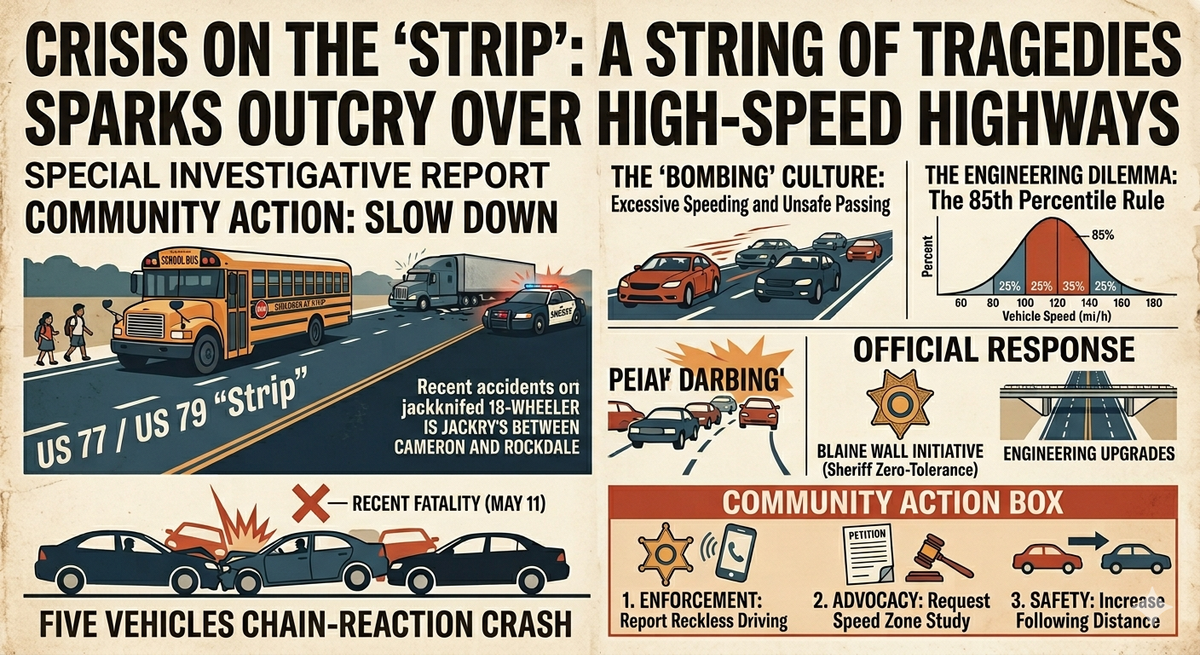
- The US 77 Five-Vehicle Chain-Reaction (May 11, 2026): Just days prior, 68-year-old Amelia Reyes Mendoza lost her life in a massive chain-reaction crash on US 77 near the CR 203 loop. In this instance, traffic had naturally slowed down due to an active construction zone. A driver failing to recognize the queue failed to reduce speed in time, slamming into the back of stopped traffic and initiating a violent domino effect. Five other individuals were hospitalized with varying degrees of injury. This crash highlighted a compounding issue on the Strip: the inability of high-speed drivers to safely react to sudden, localized traffic interruptions.
- The Rockdale ISD School Bus Crash (April 30, 2026): Perhaps the most chilling near-miss occurred when a commercial 18-wheeler jackknifed and struck a Rockdale ISD school bus that was actively unloading students. While a miracle of geometry and timing spared the 12 students on board from physical injury, the incident sent shockwaves through local school districts. It laid bare the extreme vulnerability of local school routes when forced to share narrow, high-speed, two-lane corridors with heavy commercial freight.
- The SH 36 Coyote Crossing Collision (March 16, 2026): Further complicating the regional safety profile, a fatal multi-vehicle collision occurred on SH 36 near Coyote Crossing, reinforcing fears that high-speed intersections across the county are becoming structurally unmanageable for everyday drivers.
- The US 79 Bridge Strike (January 2026): Earlier this year, a violent single-vehicle crash occurred when a driver lost control at high speed and struck a bridge structure on US 79. The impact caused severe structural debris, closing the highway for hours and exposing how unforgiving the infrastructure along the Strip can be when a vehicle leaves the pavement.
The "Bombing" Culture: Why Enforcement is Fighting an Uphill Battle
At the heart of the crisis is a deeply ingrained regional driving habit that law enforcement officials openly refer to as "bombing".
In local terms, "bombing the Strip" means traveling anywhere from 15 to 25 MPH over the posted speed limit, often combined with aggressive, multi-car passing maneuvers in narrow two-lane rural zones. On highways like US 77 and US 79, which alternate between wide passing lanes and restrictive two-lane stretches, impatient drivers frequently push the envelope, passing slower-moving agricultural equipment or commercial trucks in designated no-passing zones.
RURAL ROAD RISK FACTOR:
[ High-Speed Limit (70-75 MPH) ] + [ Impatient Passing ] = Head-on Collisions
Note: Over 50% of all Texas traffic fatalities occur on rural roadways.
According to historical transportation data, this behavior makes rural corridors disproportionately deadly. While major metropolitan areas suffer from high volumes of minor fender-enders, more than 50% of all traffic fatalities in Texas occur on rural roadways like those in Milam County. When a collision occurs at 75 or 80 MPH on a two-lane road, the physical forces involved leave virtually no margin for human survival. The state’s overall safety record reflects this grim reality: Texas has failed to record a single deathless day on its state highways since November 7, 2000.
The Engineering Dilemma: The Logic and Flaws of the 85th Percentile
Faced with mounting casualties, the immediate reaction from the public is often a demand to lower the speed limit signs. However, TxDOT (Texas Department of Transportation) operates under strict state engineering statutes that make modifying speed limits a complex bureaucratic process:
- The 85th Percentile Rule: By statutory law, TxDOT is required to conduct formal traffic speed investigations. These studies calculate the speed at which 85% of drivers naturally travel when conditions are clear. If a study shows that the majority of drivers are already traveling at 73 MPH on US 79, state guidelines mandate setting the speed limit at 70 or 75 MPH, under the assumption that the majority of drivers are inherently reasonable and safe.
- The Danger of Speed Differential: Traffic engineers argue that if a speed limit is artificially lowered—say, to 55 MPH—while 85% of the public continues to drive 75 MPH, it creates a severe speed differential. Law-abiding citizens slowing down to 55 MPH suddenly become moving roadblocks for the "bombers," dramatically increasing the frequency of high-speed rear-end pileups and volatile passing maneuvers.
- Rural Default Classifications: Because the vast stretches between Cameron and Rockdale do not meet the housing or commercial density requirements to be classified as urban or residential zones, they default to the state’s maximum rural speed allocations. Unless local districts can prove a distinct structural flaw in the road layout, the high limits remain fixed.
The Multi-Layered Response: What County and State Officials are Doing
With state engineering formulas creating a roadblock for immediate speed limit reductions, local law enforcement has stepped in to change driver behavior through aggressive, visible intervention.
Local Enforcement: The Blaine Wall Initiative
In response to the early 2026 fatalities, the Milam County Sheriff’s Office launched the Blaine Wall Initiative. Named in memory of a localized traffic tragedy, this initiative shifts the department's strategy from standard monitoring to a strict, zero-tolerance framework.
Sheriff Mike Clore has deployed saturated patrols and the department's Special Operations Unit to the Strip during peak commuting hours. Deputies have explicit instructions to eliminate verbal warnings for excessive speeding and unsafe passing. If you are caught "bombing" the road or crossing a double-yellow line to pass a vehicle, you will receive a citation. The goal is to create an immediate visual deterrent that forces drivers to check their speedometers.
State Engineering: Upcoming Infrastructure Changes
Recognizing that enforcement cannot solve structural limitations permanently, TxDOT has scheduled several critical safety upgrades for the Milam County region over the coming construction cycles:
| Grade-Separated Overpass | US 77 at FM 485 | Removes high-speed cross-traffic by elevating the primary highway, eliminating the T-bone intersection threat. |
| Highway Widening & Medians | US 79 Segments | Transforming high-risk two-lane segments into divided paths with raised or spacious center medians to prevent head-on drift. |
| Variable Speed Limits (VSL) | High-Incident Zones | Utilizing digital, real-time speed signs authorized under HB 1885 to automatically drop speed limits during heavy rain or wrecks. |
| Tactile Countermeasures | US 79 Safety Corridor | Installation of continuous centerline rumble strips to physically alert distracted drivers before they cross into oncoming traffic. |
Editorial Perspective: The Choice belongs Behind the Wheel
As community leaders compile recent crash data—using the names and dates of neighbors we have lost, from Amelia Reyes Mendoza to Michael Tyler Morton—to petition the TxDOT Bryan District for systemic safety reviews, we must confront an uncomfortable truth.
Wider lanes, rumble strips, and digital signs take millions of dollars and years of bureaucratic planning to construct. Saturated sheriff patrols cannot sit behind every single vehicle on US 77 and US 79. The ultimate authority to save a life sits in the driver's seat of your own vehicle.
The next time you find yourself stuck behind a commercial truck or a slow-moving tractor on the Strip, remember the jackknifed semi-truck, the crumpled motorcycle, and the five-car pileup. Do not attempt to "bomb" past them. Do not risk an aggressive lane change to save four or five minutes on your drive between Cameron and Rockdale.
Slow down. Stay in your lane. Wait for a designated, completely clear passing zone. A brief moment of patience is a microscopic price to pay to ensure that every commuter, school bus passenger, and neighbor returns home alive. Let’s look out for one another out there.