Did You Know? A Purple Stripe in Texas Means 'Keep Out'
If you’ve driven down a rural road in Milam County or taken a walk near a property line in Central Texas, you may have spotted bright purple stripes painted on trees, fence posts, or gate corners.

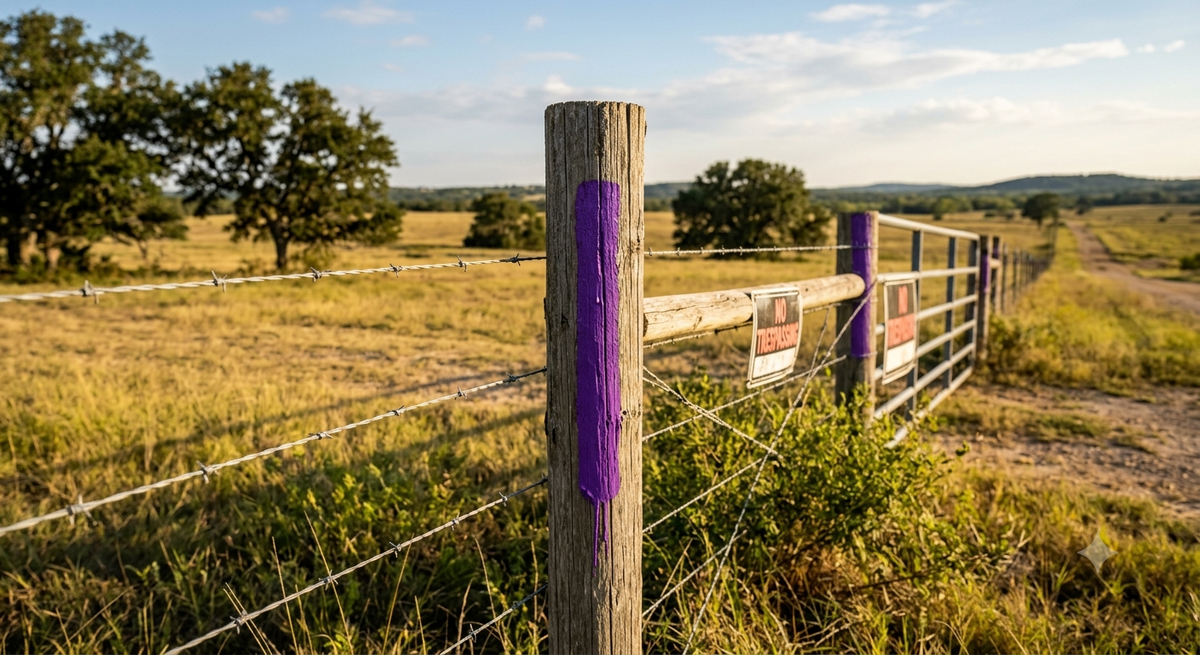
Cameron, TX - If you’ve driven down a rural road in Milam County or taken a walk near a property line in Central Texas, you may have spotted bright purple stripes painted on trees, fence posts, or gate corners.
It isn't outdoor art, and it isn't an arbitrary boundary marker. In the Lone Star State, that purple paint carries the exact same legal power as a metal "No Trespassing" sign.
Here is what local residents, hunters, and land managers need to know about Texas’s Purple Paint Law.
The Law Behind the Paint
Enacted under Texas Penal Code § 30.05, the law allows property owners to use purple paint as an official, legally binding warning against criminal trespass.
First passed by the state legislature in 1997, the rule was designed to solve a common headaches for Texas landowners: physical signs getting shot, stolen, blown over, or worn out by the summer heat. A coat of durable purple paint offers a long-lasting, low-maintenance alternative that remains clearly visible year-round.
The Legal Rules: How It Must Be Applied
Landowners can't just slap a random purple smudge on a tree and call it a day. For the paint to serve as lawful notice in a court of law, state statute mandates strict standards:
- Stripe Size: Every mark must be a vertical stripe at least 8 inches long and 1 inch wide.
- Height: The bottom of the stripe must sit between 3 feet and 5 feet off the ground.
Spacing:
- Wooded/Forest land: Marks must be placed no more than 100 feet apart.
- Open pastures/Non-forest land: Marks must be placed no more than 1,000 feet apart.
- Visibility: Stripes must be positioned so they are clearly visible to anyone approaching the boundary.
Why Purple?
Purple was chosen intentionally. It rarely occurs naturally in the Texas landscape, making it pop against trees, fence lines, and native foliage. Additionally, standard "Boundary Marker Purple" paint—available at most hardware and farm supply stores—was formulated to be easily recognizable even for individuals with common forms of color blindness.
Real Consequences for Crossing the Line
Entering or remaining on marked land without the owner’s consent constitutes Criminal Trespass.
- Standard Criminal Trespass: Typically charged as a Class B Misdemeanor, carrying penalties of up to a $2,000 fine, up to 180 days in county jail, or both.
- Aggravated Trespass: If someone crosses onto marked agricultural land or carries a firearm while trespassing, it escalates to a Class A Misdemeanor, punishable by up to a $4,000 fine and up to a year in jail.
Whether you're out exploring, hunting, or just taking a drive through the countryside, keep an eye out for those purple stripes—they mean business!