Sweet Relief: How Backyard Beekeeping Stings Property Tax Bills in Milam County
For residents of Milam County looking to ease their tax burdens, the buzz around beekeeping is entirely justified—provided they can navigate the localized rules set by the Milam Appraisal District (Milam AD).

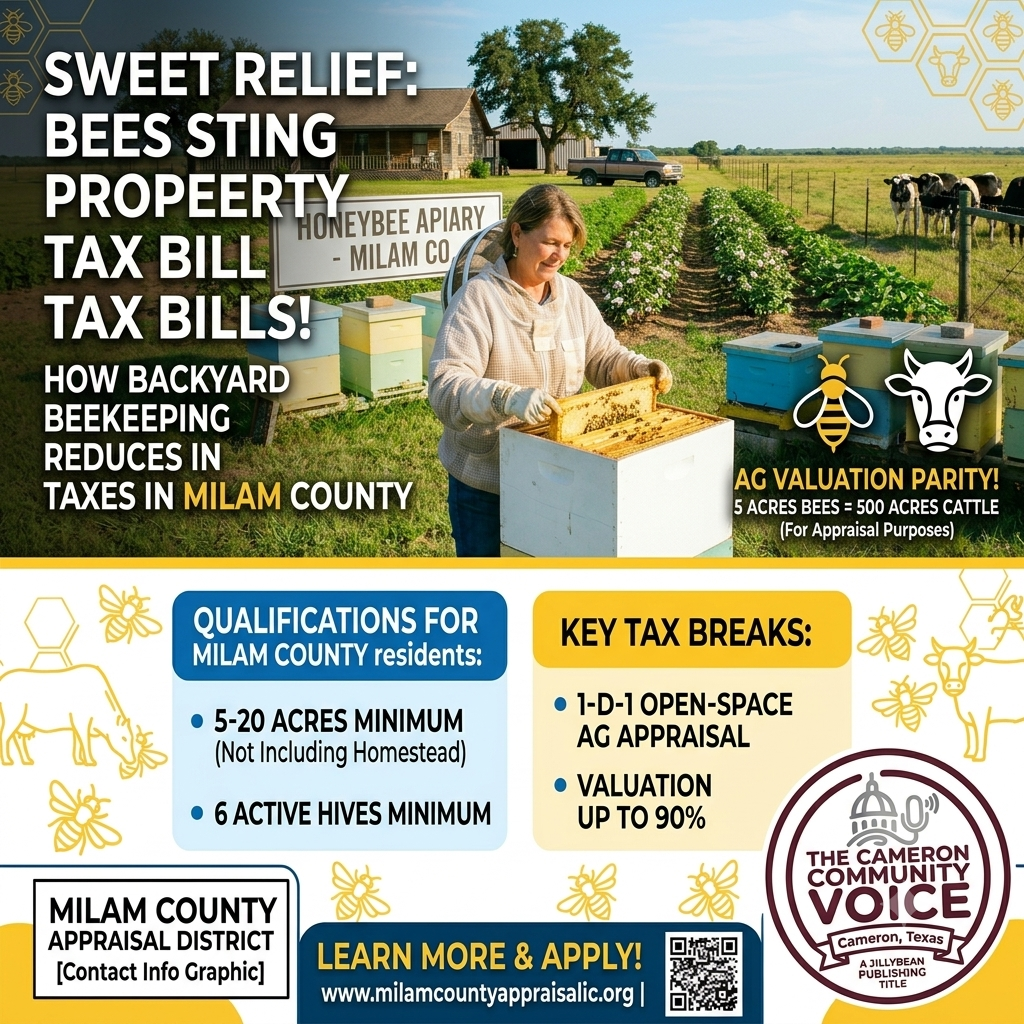
Cameron - For decades, the path to a coveted agricultural appraisal in Texas meant running heavy machinery or managing herds of cattle across expansive acreage. Small landowners were largely locked out of the system, their small-scale farming treated as a hobby rather than a contribution to the state’s agricultural economy. However, a major legislative shift formally recognized that honeybee operations are a vital part of that economy too.
Managing a honeybee operation on smaller tracts of land can grant landowners the exact same type of productivity valuation as a large-scale cattle ranch. For residents of Milam County looking to ease their tax burdens, the buzz around beekeeping is entirely justified—provided they can navigate the localized rules set by the Milam Appraisal District (Milam AD).
The Reality of the Texas "Ag Exemption"
Texas property taxes are among the highest in the nation, making tax relief a primary concern for rural residents. It is a common misconception that an "ag exemption" wipes out property taxes completely. In reality, Texas law provides an alternate open-space valuation under Section 1-d-1 of the Texas Constitution.
Instead of taxing land based on its market value (what it would sell for to a developer), the county assesses it based on its capacity to produce agricultural products. This agricultural productivity value typically runs 80% to 90% lower than market value, slashing annual tax obligations dramatically. Under Texas Property Tax Code Section 23.51(2), the "keeping" of honeybees for pollination or the production of human food or commercial products is legally recognized as an eligible agricultural use.
The Fine Print for Milam County Residents
While the state sets the baseline framework, Texas grants local appraisal districts autonomy over how these rules are strictly enforced. If you are a property owner in Cameron, Rockdale, or the surrounding rural communities of Milam County, you must meet very specific statutory criteria to qualify:
- The Acreage "Sweet Spot": Texas law establishes strict boundary lines for bee-related valuations. Your land must be not less than 5 acres and not more than 20 acres.
- The Homestead Catch: It is crucial to remember that if your primary residence sits on the property, the appraisal district will generally "carve out" an acre for the home site. This means if you own exactly 5 acres with a house on it, you only have 4 acres left for agricultural use—disqualifying you from the bee valuation. To qualify with a homestead, you typically need to own at least 6 acres.
- The History Requirement: You cannot simply buy a 5-acre lot, drop a couple of hives, and expect an instant tax break next month. The land must have a verified history of primary agricultural use for five out of the preceding seven years. If the land was already qualified under a previous owner's cattle or hay operation, you can seamlessly transition it to bees without a waiting period. If not, you must document and build that 5-year history yourself before the productivity valuation kicks in.
- Degree of Intensity: To prevent landowners from using a single hive as a token effort for tax relief, appraisal districts enforce a strict "degree of intensity" standard. According to official Milam Appraisal District guidelines, the minimum intensity standard requires **6 active hives for the first 5 acres**. For acreage beyond the initial 5, Milam AD requires a tiered scale of active hives:
- 5 Acres: 6 active hives
- 7.5 Acres: 7 active hives
- 10 Acres: 8 active hives
- 12.5 Acres: 9 active hives
- 15 Acres: 10 active hives
- 17.5 Acres: 11 active hives
- 20 Acres: 12 active hives
Ecological Infrastructure
Beyond the undeniable financial rationale, the rise of small-scale beekeeping is a massive win for Milam County’s ecosystem. Local agriculture relies heavily on cross-pollination. Without healthy bee populations, the yield of Texas staples like cotton, melons, squash, and berries plummets.
By incentivizing backyard and small-tract landowners to maintain healthy, live hives, the state is effectively outsourcing the preservation of its agricultural infrastructure to local citizens.
How to Move Forward
If you want to transition your land to a honeybee valuation, the clock is always ticking toward the spring deadlines. Landowners must fill out and file Form 50-129 (Application for 1-d-1 Open-Space Agricultural Appraisal) with the Milam Appraisal District before May 1 of the year they wish to qualify. Late applications face a steep 10% penalty and are only accepted up until the Appraisal Review Board approves the annual records in July.
For those who love the idea of the tax break but aren't thrilled about wearing a mesh suit and dealing with thousands of stinging insects, managed beekeeping services have grown rapidly across Texas. These companies will lease, install, and fully maintain the required number of hives on your property while providing you with the meticulous logbooks and documentation required to satisfy the chief appraiser.
Ultimately, the law bridges the gap between traditional ranching and modern homesteading, proving that when it comes to the Texas agricultural economy, small things can make a massive impact.