
Reducing Your Risk for Cyclospora
The Cyclospora outbreak has many people wondering what they should do with lettuce and other types of fresh produce. According to the Centers for Disease Control and Prevention (CDC), investigation of the current nation-wide outbreak is ongoing.
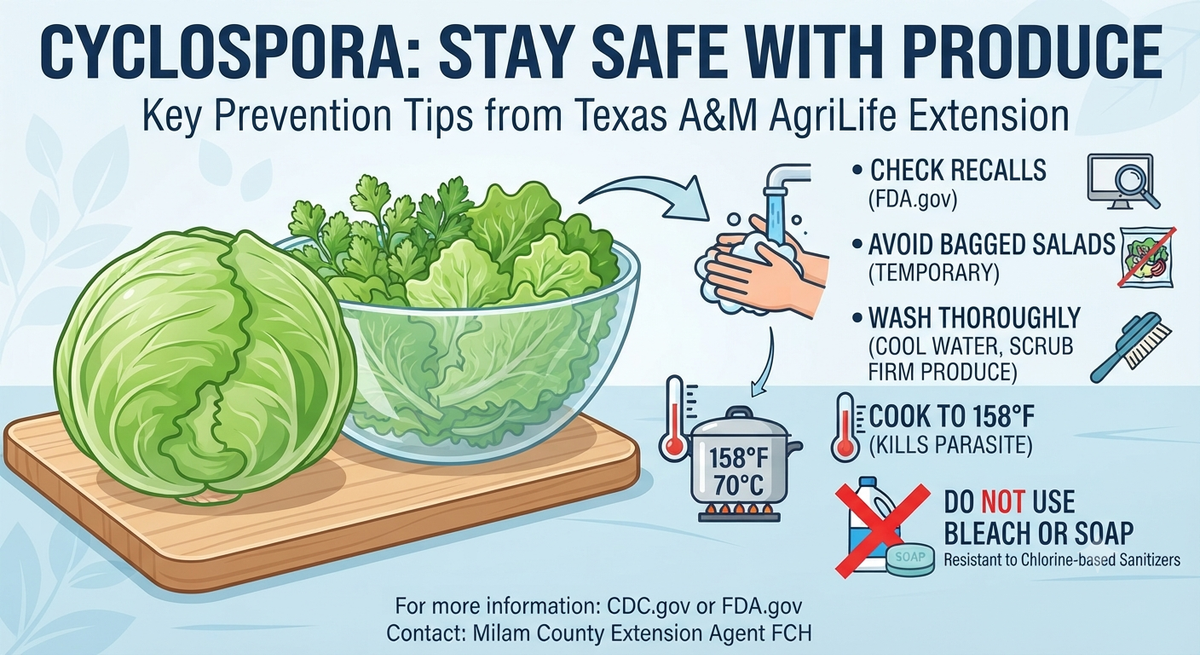
Milam County, TX - The Cyclospora outbreak has many people wondering what they should do with lettuce and other types of fresh produce. According to the Centers for Disease Control and Prevention (CDC), investigation of the current nation-wide outbreak is ongoing. Iceberg lettuce grown in Mexico is believed to be a primary source of the outbreak. Another outbreak in North Carolina has recently been reported but source of the contaminated produce has yet to be confirmed.
What is Cyclospora?
Cyclospora is a parasite spread by consuming food or water contaminated with human feces. According to the CDC, if someone consumes food or water contaminated with Cyclospora, illness (called cyclosporiasis) can appear anywhere from 2 to 14 days or even longer. Symptoms of cyclosporiasis vary from person to person and can include stomach cramps, watery diarrhea, frequent bowel movements, loss of appetite, low- grade fever, and headache. People infected with Cyclospora may experience symptoms, begin to feel better, then often experience symptoms again. Cyclosporiasis is treatable with the correct antibiotics.
Outbreaks of cyclosporiasis are not uncommon and often peak during the summer
months. They typically involve fresh produce such as lettuce, basil, cilantro, parsley, and berries.
Preventing Cyclospora at Home
How can consumers reduce their risk for becoming infected with Cyclospora? Jenna Anding, PhD, RDN, Professor and Extension Specialist with Texas A&M AgriLife Extension Service offers the following tips:
Do not eat any produce that has been recalled. A current list of recalled items
can be found on the U.S. Food and Drug Administration website:
https://www.fda.gov/food/outbreaks-foodborne-illness/investigation-9-state-
outbreak-cyclospora-illnesses-iceberg-lettuce-july-2026
Consider avoiding the use of bagged salads and other leafy greens until the
source of the outbreak is confirmed. Instead, select whole heads of lettuce, peel
off the outer leaves, and wash thoroughly.
Always begin food preparation with clean hands. Wash hands for 20 seconds
with soap and warm water. It is especially important to wash hands after using
the restroom.
Wash produce under cool, running water before peeling, cutting, or eating. For
produce with a firm and/or textured peel, use a clean vegetable brush and scrub
under running water. Cut away any damaged areas on the produce before
eating or cooking. This includes leafy greens, herbs such as cilantro or parsley,
and other fresh produce.
Prevent cross-contamination by separating fresh produce from other raw foods;
use clean utensils, cutting boards.
Individuals who are very young, elderly, pregnant, or have a weakened immune
system may want to consider avoiding raw fruits, vegetables, and herbs for the
time being. However, cooking produce to a minimum temperature of 158
degrees can kill the parasite.
Washing can remove some, but not all of the Cyclospora that might contaminate
fresh produce. The CDC cautions that Cyclospora parasites are resistant to
chlorine-based sanitizers; the use of bleach or soap to rinse produce is not advised.
For more information about Cyclospora, visit the Food and Drug Administration at
https://www.fda.gov/food/foodborne-pathogens/cyclospora or the CDC at
https://www.cdc.gov/cyclosporiasis/outbreaks/07-26/index.html.
Please make sure and go in and LIKE the page to get information about Milam County Family and Community Health! FCH facebook: https://www.facebook.com/pages/Milam-County-
Family-and-Consumer-Sciences/383866131781345.
The members of Texas A&M AgriLife will provide equal opportunities in programs and activities, education, and employment to all persons regardless of race, color, sex, religion, national origin, age, disability, genetic information, veteran status, sexual orientation or gender identity and will strive to achieve full and equal employment opportunity throughout Texas.